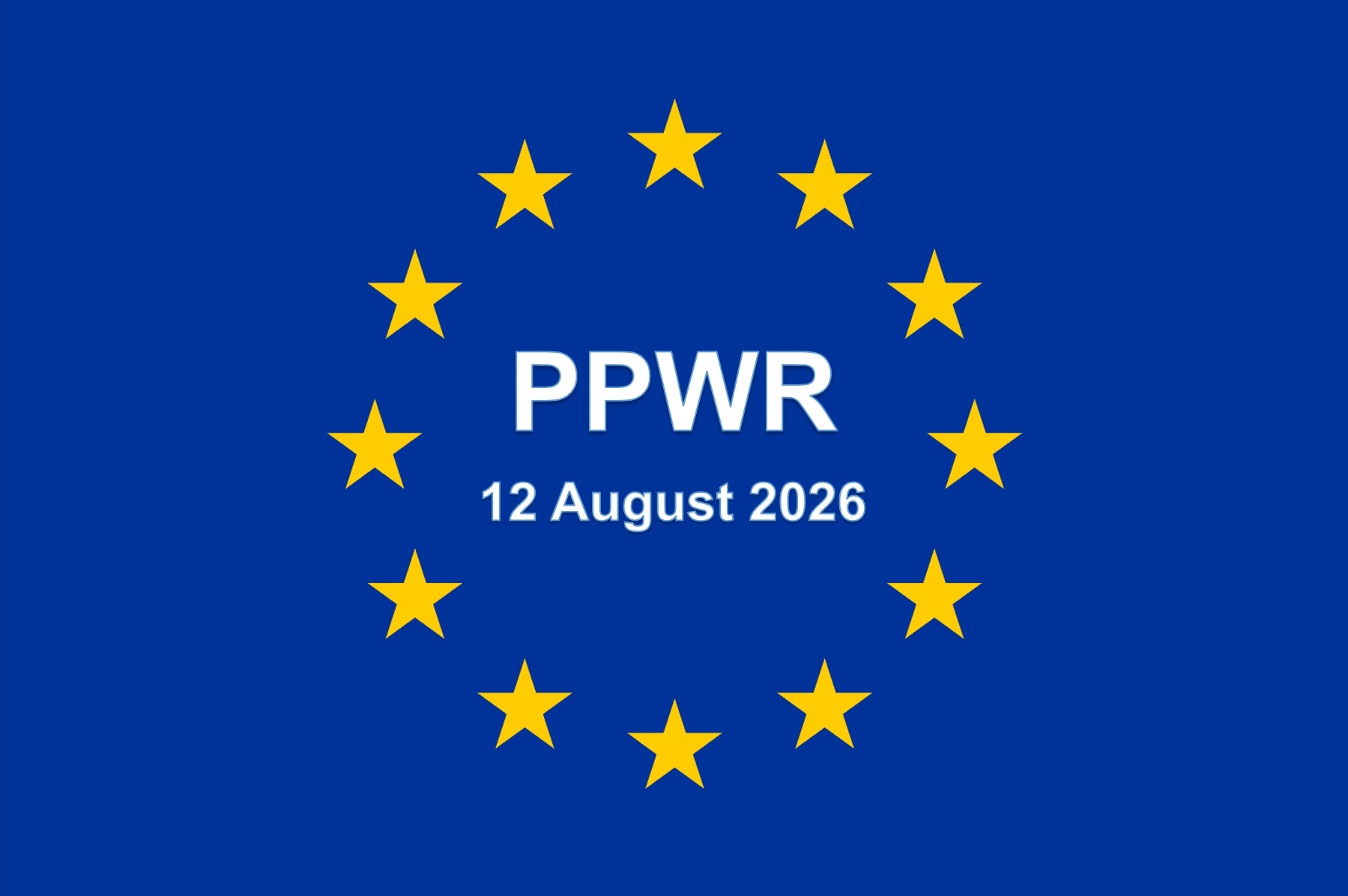
12 August 2026 marks a major milestone for packaging in Europe: the EU Packaging and Packaging Waste Regulation (PPWR) is now generally applicable. But this date should not be misunderstood. It does not mean that every PPWR requirement applies at once. Several major provisions — including recyclability performance requirements, recycled-content targets, harmonised labelling, packaging restrictions and reuse targets — follow later implementation timelines towards 2028 and 2030.
For most companies, the immediate 2026 challenge is therefore not wholesale packaging redesign. It is to establish:
- which requirements already apply,
- who carries the responsibility,
- whether compliance can be demonstrated,
- and which packaging formats need to enter the 2028–2030 preparation pipeline now
In November 2025, NYSTIO explored different recyclability performance grades defined by PPWR. In this article, NYSTIO provides a comprehensive and practical explanation to the 12 August 2026 imperatives.
EXECUTIVE TAKEAWAY
- Do all PPWR requirements apply now? No. Several major requirements become applicable later.
- Are there immediate compliance requirements? Yes. Article 5 requirements apply, including specific PFAS limits for food-contact packaging.
- Does compliance need to be documented? Yes. Manufacturers have conformity-assessment, technical-documentation and EU Declaration of Conformity obligations.
- Is the packaging supplier automatically responsible? No. Depending on the supply chain, the PPWR manufacturer may be the filler, brand owner or another operator rather than the physical packaging converter.
- Can packaging produced before 12 August still be used? Potentially yes. The key issue is notably whether it was already placed on the market and which PPWR requirement is concerned. Should companies already work on 2028/2030?
- Should companies already work on 2028/2030? Yes. The main packaging-design and portfolio requirements follow later, but preparation often needs to start well before the legal deadlines.
What actually changes on 12 August 2026?
The PPWR entered into force on 11 February 2025 and became generally applicable from 12 August 2026. It replaces the former Packaging and Packaging Waste Directive 94/62/EC and establishes a directly applicable EU framework.
Its scope is broad: the Regulation applies to all packaging, irrespective of the material used, and to all packaging waste.
However, implementation is progressive. Major requirements on recyclability and recycled content apply from 2030, while harmonised labelling, compostability requirements for certain formats, packaging restrictions and reuse targets follow their own timelines.
12 August 2026 is not a “big bang” redesign date. It is the date from which PPWR becomes an operational compliance issue.
Immediate exposure: substances in packaging
One of the most immediate areas of attention is Article 5. Packaging must be manufactured so that the presence and concentration of substances of concern in packaging materials and components are minimised.
This requirement applies broadly to packaging and is not limited to a single material or sector. The Regulation also maintains the combined concentration limit of 100 mg/kg for lead, cadmium, mercury and hexavalent chromium in packaging or packaging components.
For food-contact packaging, Article 5 introduces an additional immediate point of attention. From 12 August 2026, food-contact packaging cannot be placed on the market where PFAS concentrations are equal to or above the thresholds established in Article 5(5), unless the placing on the market is already prohibited under another Union legal act.
- 25 ppb for any PFAS measured using targeted analysis,
- 250 ppb for the sum of PFAS measured using targeted analysis
- 50 ppm for PFAS including polymeric PFAS, with additional requirements where total fluorine exceeds 50 mg/kg
Can the company demonstrate that packaging being placed on the market complies with the applicable Article 5 requirements? For food-contact packaging, this should explicitly include PFAS.
Packaging conformity: The biggest organisational change
One of the most important consequences of PPWR is the formalisation of packaging conformity. Manufacturers may only place on the market packaging that complies with the applicable requirements laid down in or pursuant to Articles 5 to 12. Before placing packaging on the market, the manufacturer must carry out — or have carried out on its behalf — the relevant conformity assessment and prepare the required technical documentation.
Once conformity has been demonstrated, an EU Declaration of Conformity must be drawn up. The technical documentation must be retained for:
- 5 years for single-use packaging
- 10 years for reusable packaging
The Commission guidance confirms that the manufacturer remains the legally responsible economic operator even where other organisations carry out parts of the conformity work. This shifts PPWR from being primarily a sustainability or packaging-development topic towards a formal product-compliance process. In practice, this will typically require coordination across Packaging/R&D, Procurement, Quality/Regulatory, Operations and the packaging supply chain. The legal responsibility sits with the relevant PPWR manufacturer, while much of the supporting information originates from suppliers and other actors in the value chain.
Manufacturers may only place on the market packaging that comply with the applicable requirements laid down in or pursuant to Articles 5 to 12.
Who is responsible: supplier, filler or brand owner?
Under the PPWR, “manufacturer” does not necessarily mean the company physically producing the packaging. Where a company has packaging or a packaged product designed or manufactured under its own name or trademark, that company is in principle considered the manufacturer.
The Commission clarifies that, for sales and grouped packaging, the manufacturer will normally be the economic operator carrying out the final processing and filling operations and placing the packaged product on the Union market.
In many FMCG configurations, the PPWR manufacturer may therefore be the company placing the packaged product under its name or trademark and controlling the packaging specifications — rather than the converter that physically produces the packaging.
For transport packaging and primary-production packaging, responsibility can sit differently depending on branding and the supply chain.
What suppliers have to provide?
Packaging suppliers must provide manufacturers with the information and documentation necessary to demonstrate conformity with the PPWR.
A supplier certificate can be part of the compliance file. But supplier documentation does not automatically transfer the manufacturer’s PPWR responsibility to the supplier. Companies should therefore know, for each major packaging family: who is the PPWR manufacturer? what evidence supports conformity? where is that evidence maintained?
NYSTIO PRACTICAL FIVE-STEP APPROACH
Below is a business-planning recommendation rather than a specific PPWR obligation. The objective is to avoid treating each PPWR milestone as a separate emergency and instead build one compliance and portfolio-management framework that can progressively absorb the next requirements.
1. KNOW YOUR EXPOSURE
Map the major packaging families placed on the EU market. Identify:
- which packaging formats are concerned?
- in which Member States they are placed on the market?
- who is the PPWR manufacturer?
- who is the EPR producer where relevant?
2. ESTABLISH EVIDENCE
Review the compliance evidence available today. Priority questions include:
- is Article 5 compliance documented?
- for food-contact packaging, is PFAS compliance demonstrated?
- can suppliers provide the information required to support conformity?
- is the technical documentation complete?
3. ASSIGN ACCOUNTABILITY
Define internally:
- who owns the PPWR conformity decision?
- who validates supplier information?
- where technical documentation is maintained?
- who approves the EU Declaration of Conformity?
- how incomplete or non-compliant files are escalated?
4. SECURE TODAY’S BUSINESS CONTINUITY
Review existing stocks and identify any packaging for which compliance evidence is missing or uncertain. Separate:
- packaging already placed on the market
- packaging produced or purchased but not yet placed on the market. For food-contact packaging, PFAS should be assessed specifically where relevant
5. PROTECT TOMORROW’S PORTFOLIO
Identify packaging formats likely to require intervention before 2028 or 2030. Prioritise formats involving:
- significant redesign
- new materials
- supplier changes
- compatibility testing
- industrial validation
- mould or equipment investment
- artwork changes
What about existing packaging stock?
This is one of the most practical issues around the 12 August date. The key point is when the packaging is first placed on the EU market – whether it is empty or already contains a product.
Packaging already placed on the market
Packaging already placed on the Union market before the relevant PPWR requirement applies is generally not required to be retroactively brought into conformity with that later requirement.
Packaging produced but not yet placed on the market
The situation is different where packaging has been manufactured or purchased but has not yet been placed on the market. The Commission provides some flexibility for packaging already in stock, particularly for certain identification requirements. But existing stock is not automatically exempt from the PPWR requirements applying from 12 August 2026. PFAS illustrates the point clearly: Food-contact packaging produced before 12 August 2026 but placed on the market after that date must comply with Article 5(5).
For legacy inventories, companies should not use production date alone. The right sequence is: When was the packaging produced? Has it already been placed on the market? Which PPWR requirement applies?
Manufacturer and producer are not the same thing
The PPWR also distinguishes between the manufacturer and the producer. They serve different purposes.
- Manufacturer: responsible for conformity of the packaging with the applicable sustainability and labelling requirements
- Producer: responsible for Extended Producer Responsibility obligations in the relevant Member State (financing packaging waste management)
Depending on the supply chain, they may be different economic operators. For businesses active in several Member States, this distinction needs to be assessed country by country.
What comes next?
12 August 2026 is only the first major operational milestone.
Starting 2028:
- Certain tea, coffee and other beverage bags and specified single-serve units become subject to compostability requirements from 12 February 2028
- Harmonised EU packaging-material labelling applies from 12 August 2028 or 24 months after the relevant implementing acts enter into force, whichever is later
Starting 2030:
From 2030, several provisions become particularly significant for packaging portfolios, including:
- Recyclability requirements
- Minimum recycled-content targets for relevant plastic packaging
- Packaging minimisation
- Restrictions on certain packaging formats
- Reuse targets for specified packaging categories
The challenge is therefore to comply with today’s requirements while preparing the formats most exposed to the next PPWR milestones.
August 2026 – NYSTIO
Sources
- Regulation (EU) 2025/40 on packaging and packaging waste
- European Commission, Guidance Document for Regulation (EU) 2025/40, C(2026) 3702, 5 June 2026
- European Commission, Packaging and Packaging Waste Regulation (PPWR) – Frequently Asked Questions, 2nd edition, August 2026
NYSTIO works with a network of relevant partners to help FMCG businesses decode the PPWR in a practical way and translate regulatory requirements into fit-for-purpose actions adapted to their specific packaging portfolios, markets and operational realities. For more information visit NYSTIO at www.nystio.com